
Lasting Remembrance is in the process of being updated. Please be aware that some links may be outdated or broken.
The Women’s Patriotic Association and The Distaff
By Terry Bishop-Stirling
The Work of the WPA
During World War One, women in Newfoundland found many ways to support the war effort.[i] Much of this work was coordinated by the Women’s Patriotic Association (WPA), organised in August 1914 by Lady Margaret Davidson, wife of Governor Walter Davidson.[ii] The group was associated with Queen Mary’s Needlework Guild, founded by the Queen at the outbreak of the war. The executive included many of the elite women from St. John’s, but its remarkable achievements were possible because it grew quickly to include women from all over the country. By November 1914 there were ninety-three outport branches, and by war’s end there were 219 WPA branches and over 15,000 members spread throughout the country. Women raised money through donations and initiatives such as entertainments and bake sales and used their traditional skills to sew and knit ‘comforts’ for servicemen. Throughout the war years the WPA distributed socks, pajamas, shirts, bed jackets and pillows to servicemen. They also began a tobacco fund, and at Xmas provided special kits of small gifts for the men.
In addition to providing comforts, the WPA set up various committees to support the war in other ways. They participated in recruitment efforts, and kept up morale through a visiting committee to visit families of servicemen, especially those whose loved ones had died, were missing, or were prisoners of war. A reception committee greeted outport recruits when they arrived in St. John’s and the WPA worked with friends in England to arrange visitors for hospitalized Newfoundland servicemen.
WPA members also devoted a great deal of their talents and energy to medical needs of the allies. By 1917 they had organised two Red Cross branches in St. John’s and seven outside the capital. Red Cross members worked with the St. John Brigade and were advised by trained nurses. They made dressings and rolled bandages, and helped organise nursing services for servicemen both at home and abroad. They also raised funds to support military hospitals overseas and to found a tuberculosis rehabilitation camp for returned war veterans. Working with other charitable groups they supported a convalescent home for servicemen. The WPA also coordinated the recruitment of women to serve at home and overseas as trained nurses or as members of the Voluntary Aid Detachment (VAD), a British organization founded in 1909 to provide helpers for nurses in military hospitals.
Discovering Women’s War Work through The Distaff
One of the best sources for those studying Newfoundland women and World War I is The Distaff, available through the Digital Archive Initiative (DIA) of Memorial University’s Queen Elizabeth II Library.
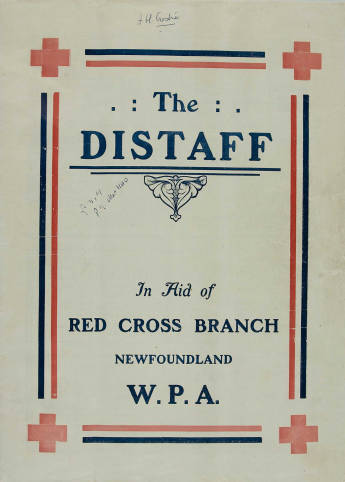
http://collections.mun.ca/cdm/ref/collection/cns_period/id/2848 (1916)
http://collections.mun.ca/cdm/ref/collection/cns_period/id/2881 (1917)
The WPA produced this small paper primarily to raise money for its Red Cross efforts and to publicize women’s war work. The success of its first edition in fall, 1916 prompted a second in spring 1917. In addition to providing a first hand account of WPA work, The Distaff showcased Newfoundland women writers, including Tryphena Duley and poet Florence Miller, and featured the photography of Elsie Holloway.[iii]
Following several pages of advertising, the 1916 edition opened with an introductory message from editor Mabel LeMessurier. She explained the paper’s name: “Our title, The Distaff, is a good old Anglo-Saxon word, which is used to express the place which women took in the home.” She went on to point out that the term was “always used by women, and was common to all ranks.” This comment reflected a common theme in WPA propaganda that war sacrifice and work was the responsibility of all women and was shared by all regions, religions and classes. This first page included a picture of two women standing next to a spinning wheel outside a modest home.

p.10 of the 1916 edition identifies these women as Mrs. Hawco of Chapel Cove “at the spinning wheel” while her daughter stands beside her carding the wool.
LeMessuier then asserted that the WPA offered “no apology” for its “venture into the sphere of journalism,” but nevertheless went on to say that their “only excuse” was their desire to raise funds for Red Cross work. This somewhat contradictory message is consistent with the content of both editions, which mix accounts of the unquestionably patriotic WPA war work, with more general stories and pictures covering women’s individual and collective contributions to various sectors of Newfoundland society before and during the war. The Distaff advanced the local women’s movement both explicitly and implicitly through pieces on the international advance of the suffrage movement, recognition of women’s voluntary work for organizations such as the Society for the Protection of Animals, and praise of women’s achievements in business and academia.
On the bottom of this opening page, two small columns entitled “Our Roll of Nurses Engaged in Red Cross Work” and “Our Probationers” (VADs) listed nine trained nurses and ten VADs. Throughout both editions researchers can find names, pictures and some biographical information on Newfoundland women who served both at home and overseas. Page 8 of the 1917 edition, for example, included pictures of Newfoundland nurses.
Later in the 1917 edition, senior nurses serving at home are highlighted in “Nurses in Public Positions.”
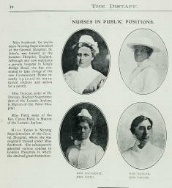
Clockwise from top left:
Miss Southcott, Miss Duncan, Miss Field, Miss Taylor
One of the best introductions to the WPA is LeMessuier’s story, “A Visit to the Headquarters of the W.P.A.,” published on page 4 of the 1917 edition. It detailed the various kinds of WPA work and highlighted the significant role of Lady Davidson; Government House was the center of WPA work. Two bedrooms were used as cutting rooms and the ballroom was equipped with tables, seats and sewing machines for fifty workers. The WPA secretary and president used the billiard room as their “war room,” coordinating all activities from there. The story provides some statistics on WPA production: by spring 1917 women had made 2,150 khaki flannel shirts, 400 pairs of pajamas, 494 nightshirts, 1,532 mufflers, 1,654 bags for hospitals, and 76 pillow cases.
Other Distaff articles focussed on particular WPA committees such as the Khaki Committee or the Visiting Committee. A notable story and picture on page 4 of the 1916 edition outlined the work of the Red Cross Committee.
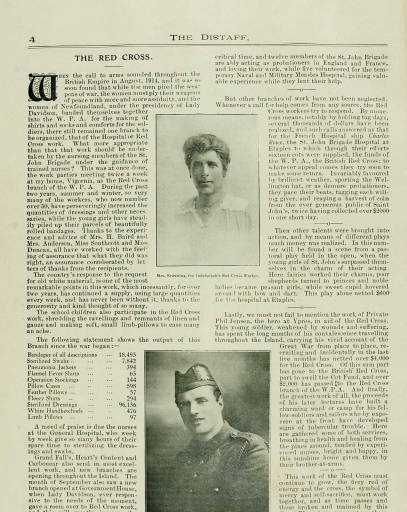
Lady Davidson, patroness of the WPA, contributed a story entitled “Comradeship” to the first edition, lauding the strength of the combined war efforts of Newfoundland women.
Now what is this Association of ours, that we call for short W.P.A.? Isn’t it the united combination of women throughout the colony – the united effort of the women of 196 towns and settlements in combination with the city of St. John’s to do their ‘Bit’, for the men fighting in the great War. There is strength in numbers.
In the same edition WPA leader and suffragette Armine Gosling asked women to consider how this talent and strength could be used after the war. She quoted several United Kingdom sources which praised women’s wartime contributions and predicted that they would be rewarded with the vote after the war. Gosling praised such “fair words” and concluded that, “when the war is over, and the task of reconstruction begins, there will be – there must be – vast changes throughout the Empire. The future of its women must be left till then on the knees of the Gods.” WPA leaders had been at the center of the pre-war suffrage movement and Gosling’s article was consistent with their decision to put their demands on the backburner, but to use women’s support for the war as evidence of their just claim to all the rights of citizens.
The Distaff provides information on many aspects of Newfoundland women’s history. It presented an early twentieth century feminist message about the strength of women and their many contributions to their country in times of war and peace. For those with a particular interest in the way women responded to World War One, it is an excellent introduction to the work of the Women’s Patriotic Association and to the way women perceived and promoted this work.
[i] Some of the material in this article is taken from author’s longer online article available at http://encyclopedia.1914-1918-online.net/article/womens_mobilization_for_war_newfoundland. Terry Bishop Stirling, “Women’s Mobilization for War (Newfoundland),” in: 1914-1918-online. International Encyclopedia of the First World War, ed. by Ute Daniel, Peter Gatrell, Oliver Janz, Heather Jones, Jennifer Keene, Alan Kramer, and Bill Nasson, issued by Freie Universität Berlin, Berlin 2015-09-30. DOI: http://dx.doi.org/10.15463/ie1418.10736.
[ii] The most comprehensive work on the Women’s Patriotic Association is Margot I. Duley, “The Unquiet Knitters of Newfoundland: from Mothers of the Regiment to Mothers of the Nation,” in A Sisterhood of Suffering and Service: Women and Girls of Canada and Newfoundland During the First World War, ed. Sarah Glassford and Amy Shaw, 51-74 (Vancouver: UBC Press, 2012).
[iii] For more on the wartime writing of Tryphena Duley see Sonja Boon, “’Just the kind of girl who would want a chap to be a man: Constructions of gender in the war stories of Tryphena Duley,” Newfoundland and Labrador Studies 25,1 (spring, 2006): 73-90. For an analysis of Florence Miller’s wartime poetry see Vicki S. Hallett, “Verses in the Dark: A Newfoundland Poet responds to the First World War,” in A Sisterhood of Suffering and Service: Women and Girls of Canada and Newfoundland During the First World War, ed. Sarah Glassford and Amy Shaw, 245-269 (Vancouver: UBC Press, 2012).