
Lasting Remembrance is in the process of being updated. Please be aware that some links may be outdated or broken.
Containing Grief: Newfoundland Newspapers and Beaumont Hamel, July-September, 1916
by Terry Bishop Stirling
Introduction
In this day of social media news is almost instantaneous, but in 1916 the people of Newfoundland depended on official sources for war news or awaited those longed for letters. There were long lines at the postal and telegraph offices, especially when there was news or rumours of new casualty lists. And, of course, they turned to the press for updates on all of the war news. The extent of the tragedy at Beaumont Hamel on 1 July 1916 led to great anxiety and pressure in the newspapers to provide information on the fate of the Newfoundland Regiment.
In addition to the delay in the relay of news and the understandable confusion in time of great crisis, wartime information was censored on both sides of the Atlantic, sometimes causing further delays and misinformation.
During the first few weeks following 1 July, 1916, the papers seemed to present the news as they received it, but whether because of pressure from government or their own patriotic beliefs, they constructed a view of the tragedy as a noble sacrifice.
As Robert Harding wrote:
What emerged was a common press image of a failed attack where death and destruction were not the most important repercussions. Of greater importance was the nobility of the battalion’s effort which provided it with the military reputation it had lacked for the first two years of the war. According to the Newfoundland press, Beaumont Hamel could not be viewed by Newfoundlanders as a tragic defeat because in actual fact it had been a resounding achievement which should make them proud of their battalion and their country.
As the losses mounted, the press, of all political stripes, stressed the bravery of the young servicemen who fought like “seasoned veterans,” and their honour in dying for King and country. The accounts, especially in letters and poems, often portrayed the fight as a crusade of right against might. Finally, once it became impossible to keep up the pretense that Beaumont Hamel was a great victory, there were still recurring attempts to find meaning in the devastation by linking the campaign to later victories. These may certainly have been the sincere beliefs of the newspaper editors, at least one of whom lost a son at Beaumont Hamel, but it was also politically necessary to help the country deal with the communal trauma and to maintain support for the continued war effort.
First reports
By the spring of 1916, while no one knew for sure, there were hints in letters home and even signs in the local paper, that the allies were ready to launch a major offensive on the western front. This 28 June editorial from The Daily Star is really quite extraordinary: it seems to be announcing the attack. Clearly this was not a concern for the censors. Presumably, if the bombardment was not enough to alert the enemy, the military authorities were not worried about a story like this in a small paper on the other side of the Atlantic.
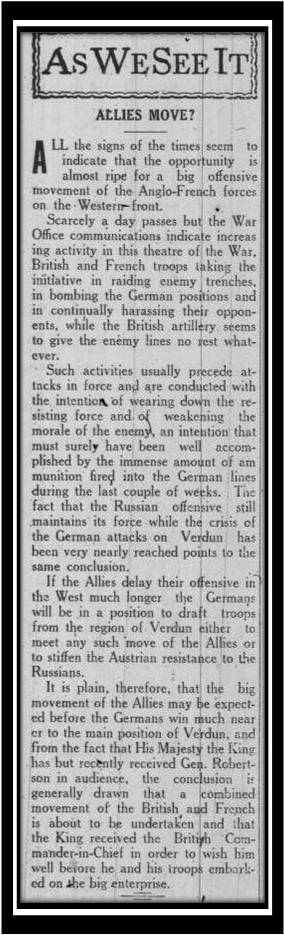
All signs of the times seem to indicate that the opportunity is almost ripe for a big offensive movement of the Anglo-French forces on the Western front.
Scarcely a day passes but the War Office communications indicate the increasing activity in the theatre of war. British and French troops taking the initiative in bombing the German positions and in continually harassing their opponents, while the British artillery seems to give the enemy no rest whatsoever.
Such activities usually precede attacks in force and are conducted with the intention of wearing down the resisting force and weakening the morale of the enemy, an intention that must surely have been well accomplished by the immense amount of ammunition fired into German lines during the last couple of weeks.
On 1 July some of the newspapers did report on the ‘Great Drive’ or ‘Great Push’ or ‘Great Advance,’ and predicted a real turning point for the war. It spoke of British gains with light casualties. At this point there was no specific reference to the Newfoundland Regiment.
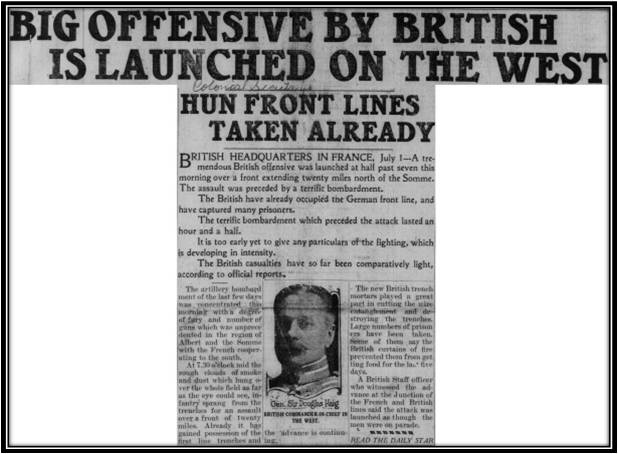
British headquarters in France, July 1 --- A tremendous British Offensive was launched at half past seven this morning over a front extending twenty miles north of the Somme. The assault was preceded by a heavy bombardment.
The British have already occupied the German front line, and have captured many prisoners.
The terrific bombardment which preceded the attack lasted an hour and a half.
It is too early yet to give any particulars of the fighting, which is developing in intensity.
The British casualties have so far been comparatively light, according to official reports.
This story ends: “A British Staff officer who witnessed the advance at the Junction of the French and British lines said the attack was launched as though the men were on parade.” (Daily Star 1 July, 1916)
This last line, though about Kitchener’s new army generally, would re-emerge: senior army officers would be quoted as admiring the Newfoundlanders who followed orders and marched on command like brave professional soldiers.
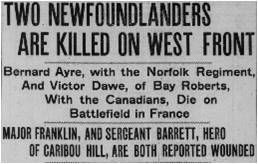
Around the 5th and 6th, the St. John’s papers began to recount the part Newfoundlanders played on July 1st. It was still within the context of a great victory, and casualties were reported as relatively light. The first reported fatalities were serving with units other than the Newfoundland Regiment. (slide 4)
On 8 July The Twillingate Sun reported on a message received from Premier Morris
Premier Morris wiring from London says no complete list of casualties yet received. Number notified to date 230.
He says London papers speak in high terms of Newfoundland troops and extend sympathy to those fallen.
Its editorial combined cautious optimism with an unfortunately accurate warning.
Judging by our own regiment and the small number wounded, with none killed so far, it looks as if the German resistance is very weak.
Of course it is too early to count the chickens. Germany may yet be able to stem the tide, and things may settle back to the old trench warfare with a few miles as the only gain. Until a German army is actually cut off, and surrenders run into six figures we may not count a victory.
It is especially gratifying to this country that our boys- the flower of our country- should be taking an active part in the great drive, whether it be the final drive, or only the beginning of a series.
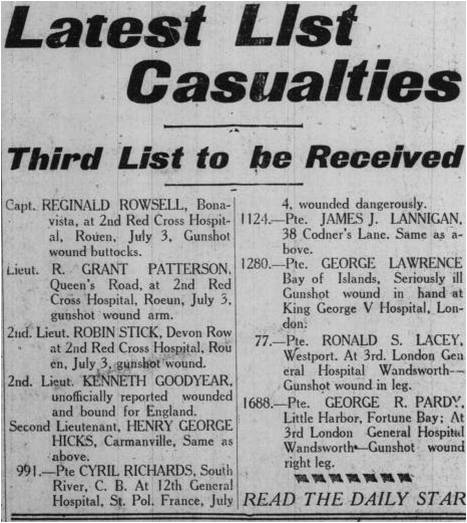
From about the 6th of July on the newspapers continued to list more and more dead and wounded.
It is easy to dismiss this delay as censorship, and it is also reasonable to assume that information on those chaotic opening days of the Somme offensive was delayed and confused. But, as indicated in Morris’ message above, it is also true that authorities tried to contact families of those on the casualty lists privately, before publishing names. Typically, families would receive a telegram. To add to the delay, government often instructed telegraph operators to postpone delivering the telegraph until the government had notified the local clergyman, or some other community leader, presumably so that they could be present to comfort the family as they received the devastating news.
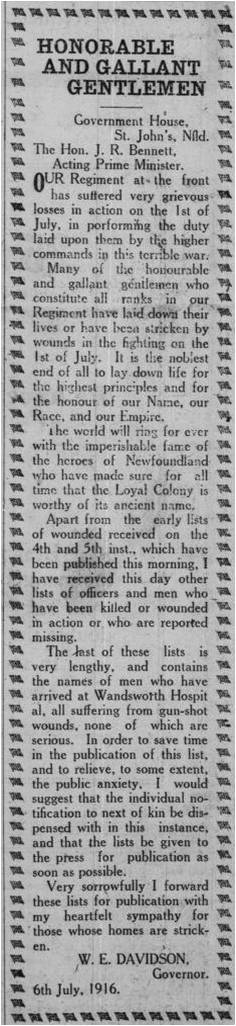
But such consideration had to be abandoned in the wake of the large scale losses at Beaumont Hamel. Undoubtedly as some families received the terrible news, rumours and anxiety began to grow. On 6 July, Governor Davidson wrote to Acting Premier J.R. Bennett, and “Very sorrowfully” passed on the long list of killed, wounded and missing which he had received that day. He suggested that given the length of the list the usual procedure of notifying families individually first should be suspended and the names published by the press as soon as possible to “relieve, to some extent, the public anxiety.” Some Newfoundlanders then, would have learned about the fate of their loved one by reading the newspaper.
The Great Advance
At first these losses were put in the context of a mighty victory, with the allies squeezing the enemy on three fronts. Stories expressed pride in the Regiment’s contribution to the advance.
The first page of the 8 July edition of The Daily Star is particularly striking; it featured many small articles with the following headlines:
Hard Fight Brings Gains
1000 Yards of Trenches Captured by the British
British Continue Successful Drive
British Troops had to Overcome Big Obstacles
Triple defeat forces enemy Withdraw Lines
King Congratulates the Gallant Troops
The Premier’s message
Huns Face Big Problem
More gains by British
First fruits of Valor for our Lads
The Governor’s praise for the Regiment, published in The Daily Star on 7 July, was one of the first messages from dignitaries which lauded their performance.
Many of the honourable and gallant gentlemen who constitute all ranks in our Regiment have laid down their lives or have been stricken by wounds in the fighting on the 1st of July. It is the noblest end of all to lay down life for the highest principles and for the honour of our name, our Race, and our Empire.
The world will ring forever with the imperishable fame of the heroes of Newfoundland who have made sure for all time that the Loyal Colony is worthy of its ancient name.
Other accolades followed, such as this note of respect and sympathy from Field Marshall Haig, published in the Evening Telegram 10 July, 1916. (slide 8)

No. 330 Telegram (Recd. 9th July, 7:30)
Newfoundland may well feel proud of her sons. The heroism and devotion to duty they displayed on 1 st July has never been surpassed. Please convey my deepest sympathy and that of the whole of our armies in France in the loss of the brave officers and men who have fallen for Empire and our admiration of their heroic conduct. Their efforts contributed to our success and their example will live.
Douglas Haig
General Aylmer Hunter-Weston, commander of the British 4 th Army’s VIII Corps wrote on 6 July to PM Morris and his message was published in The Weekly Advocate on 24 July. (slide 9)
That battalion covered itself with glory on the 1 st of July by the magnificent way in which it carried out the attack entrusted to it … There were no waverers, no stragglers, and not a man looked back. It was a magnificent display of trained and disciplined valor, and its assault only failed because dead men can advance no further.
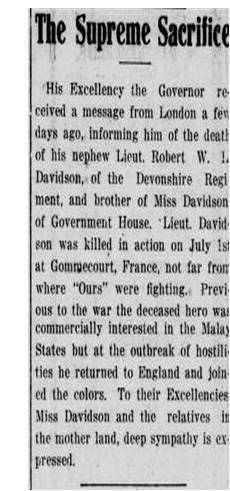
Local commentators repeated similar themes. They marvelled at how quickly the boys had become men and seasoned soldiers who “never wavered.” Several accounts told of men falling and urging their comrades to go on. They repeated their belief that the fight for Britain was worth it and their faith that their deeds would never be forgotten. Accounts of individual losses united readers and reminded them that their grief was shared. Even those providing them with the terrible news were not immune from the heartache. W.J. Herder, proprietor of the Evening Telegram lost a son at Beaumont Hamel and Governor Davidson’s nephew died elsewhere on the Somme front on 1 July.
The Mail and Advocate had an almost full page story on 8 August which was typical. By this time the full extent of the losses was known and several survivors had recounted their stories in letters home, some of which were published. (slide 11)“THE PART PLAYED BY THE NEWFOUNDLAND REGIMENT IN THE BIG DRIVE, JULY1st”
The Newfoundlanders were given what is now recognized to have been an impossible task, and although they failed the story of their bravery and daring will live forever.
After describing the fate of the other British troops who went before them, the story continued:
Now came the turn of the Newfoundlanders. The fate which had overcome their comrades daunted them not one bit. These boys - their average age was under twenty-four – were as steady as veterans, as steady as on the parade in St. John’s when they embarked for England to fight for the Empire. Not a man hesitated. With a cheer they were over the parapet …
Officers fell right and left, but as they fell, they waved their men on, “Right to it this time,” was the cry. … Companies melted away, but as each man fell, he always cried “Now right on boys, right to it this time”- that was their slogan.
Looking for meaning
This passage was one of the first to refer to the failed attempt. By that time, it had become difficult to keep up the talk of a glorious victory. But there were still attempts to see positives and to link the action which began on 1st July to later victories.
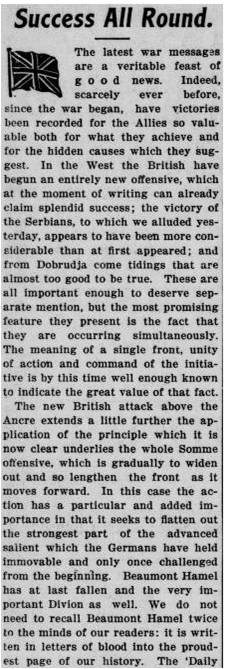
As early as 10 July the Evening Telegram began to re-cast July 1st as the beginning of a broader longer-term advance which now challenged German troops at several points.
For this reason, the success of one of the Allied drives is not to be measured by the progress it achieves, but also by advances made possible elsewhere, and the advantage to the Allies position viewed as a whole.
Perhaps the most significant aspect of the Somme offensive, as it is now known, has been the resumption by the British of the drive forward.
The purpose, this article maintained, was not merely to draw the Germans away from one other point (Verdun), “but to show that nothing less than a systematic sustained pressure is intended upon the German lines, until these lines break, or it is apparent that they cannot be broken.
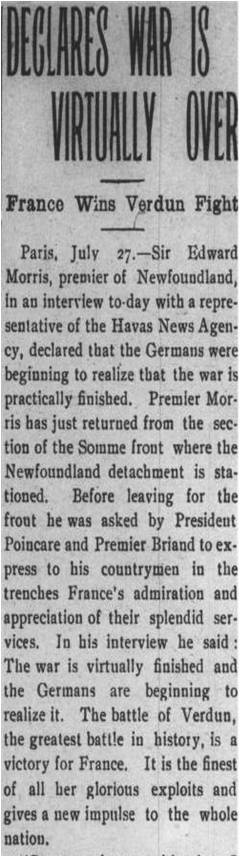
In November the papers reported that the allies had finally taken Beaumont Hamel. Some accounts linked this and the relief of Verdun directly to the action begun on 1 July. Perhaps readers would be comforted by direct or indirect linkages between these later victories and their earlier losses.
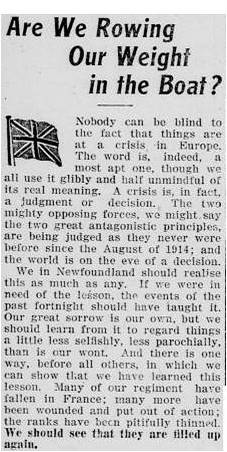
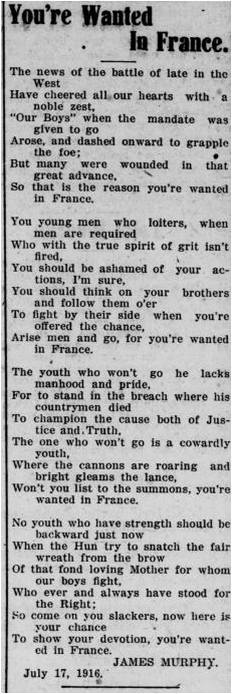
Not surprisingly all of these stories were accompanied by calls for more men to replace those who had fallen. Keeping up morale and recruitment was an overwhelmingly difficult task in those days. Appealing to honor and duty had always been central to recruiting drives but now Newfoundland had heroes, and men were called to take up their fight so that they would not have died in vain. Young men were urged to sign up, and there were also calls for conscription.
Others were urged to give money or their time to support the war effort in whatever way they could as a way to honor the fallen.
Tragedy, Grief, Nobility: Letters and Poems
The editorials and news stories recounting the valour of the Regiment continued and all of the papers present numerous such accounts. Reporters’ stories were augmented by letters from soldiers and their families, and poems written by family and friends.
Many of the letters described soldiers’ experience, but those published often included notes of humour or reassurance, such as the following letter from Pte William Mitchell to his mother, 47 Spencer St. St. John’s.
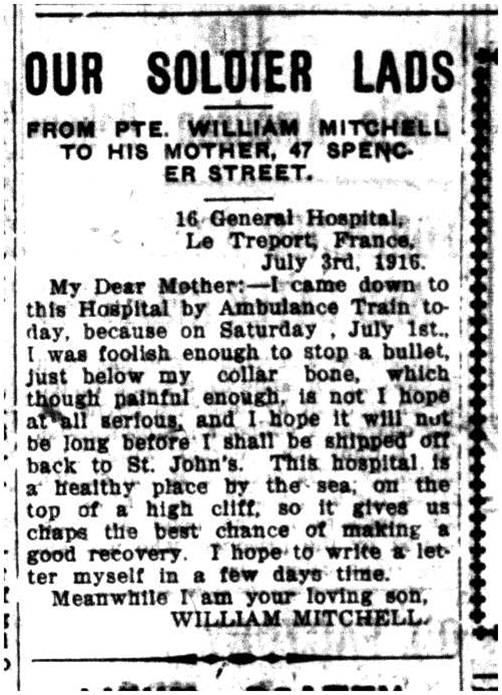
15 General Hospital Le Treport, France July 3 rd, 1916
My Dear Mother: I came down to this hospital by Ambulance Train today, because on Saturday, July 1 st, I was foolish enough to stop a bullet, just below my collar bone, which though painful enough, is not I hope at all serious, and I hope it will not be long before I shall be shipped on back to St. John’s. This hospital is a healthy place by the sea’ on the top of a high cliff, so it gives us chaps the best chance of making a good recovery. I hope to write a letter myself in a few days.
Meanwhile I am your loving son, William Mitchell
But no matter how ‘cheerful’ or positive they tried to be, many of the letters revealed more of the real horrors the men had faced.
On the 22 July The Evening Telegram published a letter by soldier, Bert Ellis, which repeats the theme of bravery and honor but also reveals the stark reality which the men had endured. (slide 15)
The Newfoundland Regiment is about done. They stood to their guns almost to the last man and fought like those who have no fear. When the roll was called only 43 answered. When I was crawling back I was all alone and never met a soul all the way back, which was 400 yards, only Dead! Dead! Everywhere. The awful sight, it made me so sick that I used to lie down and wonder if I would go on or stay there .
He continued:
Our boys acted throughout like heroes. They went up on top singing just as if they were going on a march instead of facing death. The place we went over, or just in front of us, was called the happy Valley or the Vale of Death … But our boys showed no fear.
Did the way the military, the government and the press deliver the message about Beaumont Hamel as a noble and worthwhile sacrifice help people to cope and to go on? That is difficult to answer – people did continue to work at home, and men continued to enlist, though in declining numbers. Letters from parents in the press and in the soldiers’ files do repeat many of the same themes – their sons died a good death fighting for a just cause. But newspaper research can more readily depict the message presented than the impact or reception of that message.
There are other stories such as those revealed in the correspondence of Catherine Anderson whose son was listed as missing at Beaumont Hamel and then officially declared dead. She wrote the governor and the military authorities on 21 May, 1917 more than 10 months after the battle. This letter, included in her son’s official military records, reveals that she, and perhaps others, still struggled to accept what had happened on July 1 st.
To whom it may concern. [I] don’t know if this is the correct address…. I am sending my darling son’s photo to you to see if it will be of any use to you as there are now hopes of being able to trace our missing men. You will see by the photo that he was posted as missing on July 1st 1916 and later I was sent official notice that he was believed killed in action, but there are many of us who believe they are alive. If you have any proof of my son’s death will you kindly send such to me, his broken-hearted mother.
( https://archivalmoments.ca/2015/06/his-broken-hearted-mother/)
It is to sources like this we need to turn to see the personal grief. It is hard to capture from newspaper research, though it does come through in some of the letters and particularly in the poetry, good and bad, that was frequently published in the press.
The following poem, published in The Evening Telegram on 10 July, was written by a man in memory of his childhood friend. It is a poignant tribute which juxtaposes the innocent youth with the fallen soldier, and you feel the author’s sorrow and shock that his boyhood friend was so quickly a soldier and then so quickly gone. The honors and praise gave him little comfort.
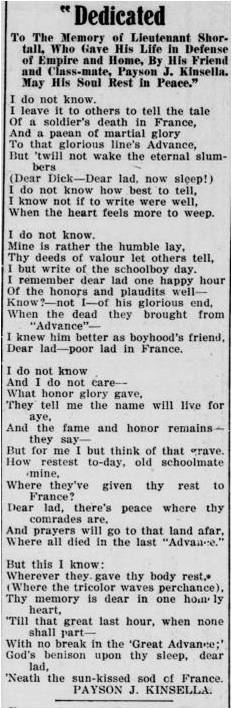
“Dedicated”
To the Memory of Lieutenant Shortall, who Gave His life in defense of Empire and Home, by his friend and classmate, Payson J. Kinsella. May His Soul Rest in Peace
I do not know.
I leave it to others to tell the tale
Of a soldier’s death in France,
And a paean of martial glory
To that glorious line’s Advance,
But t’will not wake the eternal slumbers.
(Dear Dick –Dear lad, now sleep!)
I do not know how best to tell,
I know not if to write were well,
When the heart feels more to weep.
I do not know.
Mine is rather the humble lay,
Thy deeds of valour let others tell,
I but write of the schoolboy day.
I remember dear lad one happy hour
Of the honours and plaudits well-
Know? -not I – of his glorious end,
When the dead they brought from
“Advance” –
I knew him better as boyhood’s friend,
Dear lad – poor lad in France.
I do not know
And I do not care –
What honor glory gave,
They tell me the name will live for aye,
And the fame and honor remains –
they say-
But for me I but think of that grave.
How restest to-day, old schoolmate
mine,
Where they’ve given thy rest to France?
Dear lad, there’s peace where thy comrades are
And prayers will go to that land afar,
Where all died in the last “Advance.”
But this I know:
Wherever they gave thy body rest,
(where the tricolor waves perchance).
Thy memory is dear in one homely
Heart,
‘Till that great last hour, when none shall part-
With no break in the “Great Advance;”
God’s benison upon thy sleep, dear lad,
‘Neath the sun-kissed sod of France
Payson J. Kinsella
A note on sources
During World War One newspapers were an essential source of war news, and today they are equally important for researchers studying that period. Memorial University’s library has copies of extant newspapers of that time, several of which have been digitized and are available online. For those using newspapers for historical research, a good starting point is the Historical Directory of Newfoundland and Labrador newspapers, available online at www.library.mun.ca/cns/nlnews/indexes/
This paper draws on three of the St. John’s dailies: The Daily News; The Daily Star and the Evening Telegram as well as the Mail and Advocate, the newspaper of the Fishermen’s Protective Union, and two regional papers, The Twillingate Sun, and the Western Star.
For those who are interested in looking more deeply into this subject or want to explore the longer term political and cultural impacts of 1 July, 1916 see:
Cadigan, Sean. Death on Two fronts: National Tragedies and the Fate of Democracy in Newfoundland, 1914-34. Toronto: Penguin Canada Books Inc., 2013.
Harding, Robert, ‘Glorious Tragedy’: Newfoundland’s Cultural Memory of the Battle of Beaumont Hamel, 1916-1949,” MA Thesis, Dalhousie University, 2004.
Harding, Robert. “Glorious Tragedy: Newfoundland’s Cultural Memory of the Attack at Beaumont Hamel, 1916-1925,” Newfoundland and Labrador Studies 21,1 (Spring, 2006): 3-40.
https://journals.hil.unb.ca/index.php/NFLDS/article/view/5884/6892
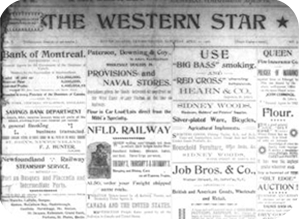
The Centre for Newfoundland Studies has digitized wartime Newfoundland newspapers The Evening Telegram, The Western Star, and The Daily Star.