
Lasting Remembrance is in the process of being updated. Please be aware that some links may be outdated or broken.
The Newfoundland Naval Reserve and Local Newspapers during the First World War
By Mark C. Hunter, PhD
The Newfoundland branch of the Royal Naval Reserve was
established in 1900 by the Royal Navy to test how
colonies would contribute to imperial defence. For
Newfoundland fishermen the reserve became a source of
employment and cash in a largely cashless society.
Between 1900 and 1914, about 1,300 men enrolled in the
reserve and during the First World War, 1,730
Newfoundlanders enrolled and filled vessels of the Royal
Canadian Navy, patrolling the east coast for enemy
vessels, and ships of the Royal Navy. In the latter role
they worked the North Sea on blockade duties, on landing
craft bringing soldiers ashore during the Gallipoli
Campaign, and in other roles.[1] Their
experiences were different than those of members of the Newfoundland
Regiment, who served as a group, and fought in famous battles
like the Battle of Beaumont Hamel. During the war, 192 Newfoundland
reservists died on numerous vessels in different locations.
With no famous battle to forge a national memory around,
the individual experiences of reservists, and how they were
reported in the Newfoundland press, are important sources
to reveal life at sea during the conflict and their treatment
when they returned home after the armistice.[2]
The politics of local newspapers and the nature of work at sea shaped newspaper reporting on the activities of Newfoundland reservists. This is illustrated by two newspapers: the Fishermen’s Protective Union’s (FPU) Mail and Advocate and the St. John’s Daily News. During the war, William Coaker, leader of the FPU, was the editor of the Mail and Advocate. Initially critical of the war effort, Coaker and the FPU’s political wing, the Union Party, joined with Prime Minister Edward Morris’s People’s Party in 1917 to form a wartime national government.[3] At the outbreak of the war in 1914, however, there was significant political tension between the government and the FPU, with the Union Party’s efforts to advance policies in Newfoundland’s legislature, the House of Assembly, blocked by the merchant dominated upper house, the Legislative Council.[4] The editorials in the FPU newspaper at the outbreak of the war contained headlines such as “That Outrage,” “Popularity, Patriotism, Partisanship,” “The Plot Exposed,” and “The Government is Blundering.” On 6 August 1914, Coaker declared in the Mail and Advocate that it was shameful that the people of St. John’s frolicked and celebrated the annual Regatta and he called for the legislature to reopen to discuss the critical affairs of the nation.[5] The FPU blamed the Morris government for Newfoundland’s economic problems.[6] The FPU believed that the real reason the government was forming a Newfoundland regiment of 500 men, and expanding the naval reserve from 600 to 1,000 men, was to prepare for domestic unrest, rather than to defend the Empire. The FPU believed that “the Government and Governor dread[ed] the trouble of facing a winter with so many of the people unprovided for.” [7] The Mail and Advocate declared that “No Germans in Europe would rule this land worse than the Germans of Newfoundland[.]”[8] Nevertheless, after the regiment left St. John’s to a grand farewell on 3 October 1914,[9] the Mail and Advocate called on Newfoundland fishermen to meet the demand for more naval reservists. It urged fishermen to “[s]how those land-snipes that the North has as much love for the Empire and Flag as the best anywhere in the Colony.”[10]
For the period 1914 to 1918, the most useful Newfoundland newspaper for the historian conducting research on the Great War is the Daily News because it carries stories about the Newfoundland Regiment and the Newfoundland Naval Reserve and did so generally in a less biased and political manner than the Mail and Advocate. Initially a Tory-leaning newspaper, the Daily News generally supported the Morris’s People’s Party and after 1917, the wartime national coalition government that included the Union Party.[11] Letters from reservists published in the Daily News paint a picture of life at sea and make comparisons to the traditional work at home as a fishermen. Reservist Lorenzo Ash, from Carbonear, for example, wrote in 1915 that he expected to soon be mine-sweeping. He knew that it was “a kind of a dangerous job, but that is nothing to fear, as I have often run bigger risks taking a trap from under an island of ice.”[12] Similarly, Richard J. Ryan, then on duty on HMS Roxano, told his brother Ned that “I often heard father talking about the big sea going over the ships … I guess I am after seeing some big ones this winter.”[13] Nevertheless, the contrast between comparing life at sea while fishing with life in combat was stark. Reservist Jim Bewhey, serving on one of the Dardanelles landing craft in 1915, told his father that “[w]e lost a great many on landing the troops, which was a very ticklish operation. We have been hit three times, and one shell, the last one, failed to explode. The first one went in at the quarter deck … The second one wrecked one of our boats … and it did no further damage; in fact in all three cases I am very pleased to say there was no loss of life.”[14]
The stories from letters in the Daily News were the individual accounts of the sailor, often reflecting back on their lives before the war, and the nature of combat at sea. When reservists would return home individually or in small groups during the war, the Daily News carried stories about the official welcoming ceremonies attended by officials like the Prime Minister. The Daily News explained that the work of the reserve was just as important as that of the regiment, but the reserve’s work was “less conspicuous than that of their brethren of the junior service, who possess the additional advantage of being together in one unit and now and then find opportunity for spectacular action.”[15] On 8 March 1918, a reservist family member added that “soldiers on the land can meet his enemy face to face, and know where the next attack will be, but the poor sailor’s enemy is prowling and crawling in the depths below.”[16] Work and war at sea was different than on land and shaped the portrayal of the reserve in the local press. There was no single great battle to report upon to remember the exploits of the naval reservist.
The autumn of 1918 saw the end of the war and the demobilization of the reserve, whereupon the nature of naval warfare became prominent in the local press as the reservists sought their “prize money,” or their share of the proceeds from the disposal of captured enemy ships. The Newfoundland government had held out the prize money as an incentive to the reservists. When thirty of them returned home for Christmas in 1916, Prime Minister Morris told those gathered that “at the end of the War there would be a considerable amount of prize money to share, but they were not fighting for that” but for patriotic reasons.[17] When the war ended, the British distributed the money to the Newfoundland government, but the latter held onto it to offset some of the expenses of the Department of Militia. Denied what the reservist believed was their traditional right to the money, established by years of naval practice, once they returned home they united as a group and fought for their rights as sailors. This unity of action gave the local press more to report upon about the reserve as a group than did their individual exploits during the conflict. On 16 March 1921, members of the reserve held a meeting at the Longshoremen’s Protective Union (LSPU) hall in St. John’s to discuss the fact that they had not received their prize money.[18] The Daily News letters to the editor became an import outlet for their frustration. One reservist exclaimed that they had “kept that awful monster from devouring some of those fine gentlemen who are at this time enjoying the fruits of our labour” and if they had known the hardships of the reservists at sea, there would be no “doubt they would be putting up a kick also.”[19] The reservist explained that “what we got we honestly earned and the Prize Money is a thing that is rightly ours and it is not their place to keep it from us.” [20]
In July 1921, still without their prize money, the reservists marched on the Colonial Building, the seat of the Newfoundland legislature, the House of Assembly. It opened at 3.15 p.m. on 11 July 1921 with members of the reserve in the audience, who subsequently presented a petition. The Prime Minister, Richard Squires, explained to them that they had been paid “in lieu of the Prize Money,” had relinquished all claims to it, and the money received from Britain “would be placed to the credit of the [Newfoundland] Department of Militia to square up accounts.”[21] The opposition was dominated by members who had formerly served in government, were intimately familiar with the war effort, and who contradicted Squires. John R. Bennett was formerly the Minister of Militia, Sir John Crosbie had been Minister of Shipping in 1919, while Sir Michael Cashin, leader of the opposition, had been Minister of Finance and Customs during the war, and briefly Prime Minister after the conflict.[22] Cashin believed that the men had a right to the money and that the policy of the previous coalition national government was irrelevant. Bennett also contended that he “did not think the question of prize money was ever considered by the late Government.” Crosbie agreed with Bennett and Cashin that the prize money was awarded by the “Prize Courts of the Empire and there is no object in keeping the men from their rights.”[23] Crosbie explained that the Militia Department’s need to use the money to “square accounts … was not mentioned in the Budget Speech or the Estimates.” Others noted that “If we can find $1,500,000.00 to give Reid to run the Railway, surely goodness we can find $100,000.00 to pay the men who fought for us especially when it is only a question of handing them what is their own and not ours.” In the end, the motion in the House to give the men their prize money passed 17 to 14.[24] However, it would remain many months, into 1922, before the reservists began receiving their money and into 1923 before the final payment was made to the men. Throughout the controversy, the Daily News remained firmly on the reservist’s side. It wrote that the “Prize-Money is Britain’s, not Newfoundland’s to award; it is Jack Tar’s not the [Newfoundland] Militia Department’s to receive.”[25]
The reporting on the Newfoundland Naval Reserve was shaped by the nature of warfare at sea and politics on land. The naval reserve that was established in Newfoundland had a relatively long history in the country, especially in the outports, before the outbreak of the war. In contrast to the Newfoundland Regiment, which served on land as a group, the reserve deployed to scattered ships at sea. These vessels contributed to the war effort, but when Newfoundlanders died at sea, they often slipped below the waves leaving family members and the country with no physical location to gather for mourning or commemoration. The local newspapers like the Daily News reported on the exploits of the reservist when those who could wrote home. The newspaper also ensured that reservists were acknowledged when they returned home, but recognized the difference between war at sea and war on land and how this impacted its reporting. Often, with no grand exploits to report, the most prominent coverage of the reverse came at the outbreak of the war, when the FPU tried to use the war as a wedge issue before it joined the national wartime coalition government in 1917, and after the war when the reservists were able to come together as a group in St. John’s to fight for their prize money. The discourse between political life at home and work at sea shaped the coverage of reservist exploits from the outbreak of the conflict to post-war demobilization.
[1] Mark C Hunter, To Employ and Uplift Them: The Newfoundland Naval Reserve, 1899-1926 (St. John’s, NL: ISER Books, 2009), 33-50; 52-57; 99-105; and 115-135.
[2] Michael Hadley observes, for example, that “the bloody battle between ships on the high seas leaves neither trace of carnage nor sites for national shrines” (Michael L. Hadley, Count Not the Dead: The Popular Image of the German Submarine [Montreal: McGill-Queen’s University Press, 1995], x). For details of the forging of national memory around the Newfoundland Regiment Robert J. Harding, “Newfoundland’s National Victory: The Triumphant Symbolism of Beaumont Hamel Memorial Park,” Aspects 41, no. 1 (2005): 30-37 and Jerry Bannister, “Making History: Cultural Memory in Twentieth-Century Newfoundland,” Newfoundland and Labrador Studies 18, no. 2 (Fall 2002): 175-194.
[3] S.J.R. Noel, Politics in Newfoundland (Toronto: University of Toronto Press, 1971), 119-127; “Fishermen’s Advocate, The,” Encyclopaedia of Newfoundland and Labrador; Suzanne Ellison, “Fishermen’s Advocate,” Historical Directory of Newfoundland and Labrador Newspapers, http://www.library.mun.ca/cns/nlnews/title/df/ . See also, Hunter, To Employ and Uplift Them, 93-97.
[4] Noel, Politics in Newfoundland, 119-120 and 295.
[5] “Mr. Coaker asks for Immediate Opening of the Legislature,” Mail and Advocate, 6 August 1914.
[6] “Popularity, Patriotism, Partisanship,” Mail and Advocate, 19 August 1914, p. 4.
[7] “The Plot Exposed,” Mail and Advocate, 20 August 1914, p. 4. Newfoundland regiment and naval reserve expansion numbers are from Heritage Newfoundland & Labrador, “Recruiting the Newfoundland Regiment,” Newfoundland & Labrador in the First World War, http://www.heritage.nf.ca/first-world-war/articles... and Hunter, To Employ and Uplift Them, p. 99.
[8] “The Government is Blundering,” Mail and Advocate, 19 September 1914.
[9] “Newfoundland Sends her First Contingent for Service Abroad,” Mail and Advocate, 5 October 1914, p. 1.
[10] “Fishermen, Attention!” Mail and Advocate, 5 October 1914, p. 4.
[11] “Daily News,” Encyclopedia of Newfoundland and Labrador, http://collections.mun.ca/PDFs/cns_enl/ENLV1D.pdf; Suzanne Ellison, “Daily News,” Historical Directory of Newfoundland and Labrador Newspapers, http://www.library.mun.ca/cns/nlnews/title/df/; and Jeff A. Webb, “Responsible Government, 1855-1933,” Heritage Newfoundland and Labrador, http://www.heritage.nf.ca/articles/politics/responsible-government-1855-to-1933.php.
[12] Lorenzo Ash, from Carbonear, Devonport, 9 April 1915, reprint in Daily News, 11 May 1915, p. 5.
[13] Richard J. Ryan, from Bell Island, HMS Roxano, 9 April 1915, in Daily News, 11 May 1915, p. 5.
[14] Jim Bewhey to his Father, 30 June 1915, reprint in Daily News, 3 August 1915, p. 3.
[15] “Praise for our Reservists,” Daily News, 5 May 1917, p. 4.
[16] “Appreciates R.N.R.” letter from A Sister of a R.N.R. to Editor Daily News, 8 March 1918, in Daily News, 11 March 1918, p. 2.
[17] “Christmas Welcome Home to Naval Reservists,” Daily News, 12 December 1916, p. 4.
[18] “Reservist Meet. Will ask for Prize Money,” Daily News, 18 March 1921, p. 10.
[19] Ex-Reservist, “Prize Money,” Daily News, Letter to the Editor, 29 March 1921, p. 8.
[20] Ex-Reservist, “Prize Money,” Daily News, 29 March 1921, p. 8.
[21] “House of Assembly Proceedings. Naval Reservists At Bar,” Daily News, 12 July 1921, p. 5.
[22] “Bennett, Sir John Robert,” “Crosbie, Sir John Chalker,” and “Cashin, Sir Michael Patrick,” Encyclopedia of Newfoundland and Labrador, http://collections.mun.ca/PDFs/cns_enl/ENLV1C.pdf .
[23] “House of Assembly Proceedings. Naval Reservists At Bar,” Daily News, 12 July 1921, p. 5.
[24] “House of Assembly Proceedings. Naval Reservists At Bar,” Daily News, 12 July 1921, p. 5.
[25] “Prize Money,” Daily News, 12 July 1921, p. 4.
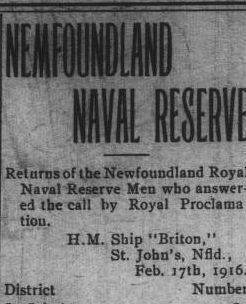
You can find wartime newspapers from Newfoundland and Labrador in the Centre for Newfoundland Studies